

Shopify merchants have started sending me screenshots of ChatGPT answers. A few are excited because their brand showed up in a product recommendation. Most are uneasy because a competitor showed up and they did not.
That unease is usually how the GEO vs SEO conversation starts on my calls. I have spent years helping Shopify merchants grow their Shopify stores, and my honest answer is that you need both, just not in equal measure and not for the same reasons.
Most Shopify merchants I talk to feel like they are falling behind. They have just started to get comfortable with SEO, and now there is a new term they are told to worry about. Many of them think they have to start from zero.
They don’t. If you have spent time making your Shopify store easy to find on Google, that work still counts. You just need to know what to keep doing and what to add. To figure that out, start by understanding what each one does:
SEO stands for search engine optimization. It simply means making your website easy for Google to find, read and show when someone searches for something. When a person types a search, Google picks the pages it thinks will answer it best and lists them. SEO is the work you do so your pages are among the ones Google picks, and ideally near the top where people actually click.
It covers what you write on your pages, how your pages are set up, how fast they load and whether other websites trust you enough to link to you.
On a Shopify store, each type of page has its own SEO job. Collection pages usually rank for broad searches like “baby rompers,” product pages for specific ones like a fabric, size or style, and blog posts for questions shoppers ask before they are ready to buy.
When I review a Shopify store, I often find all three competing for the same search, which makes it harder for any one of them to rank.
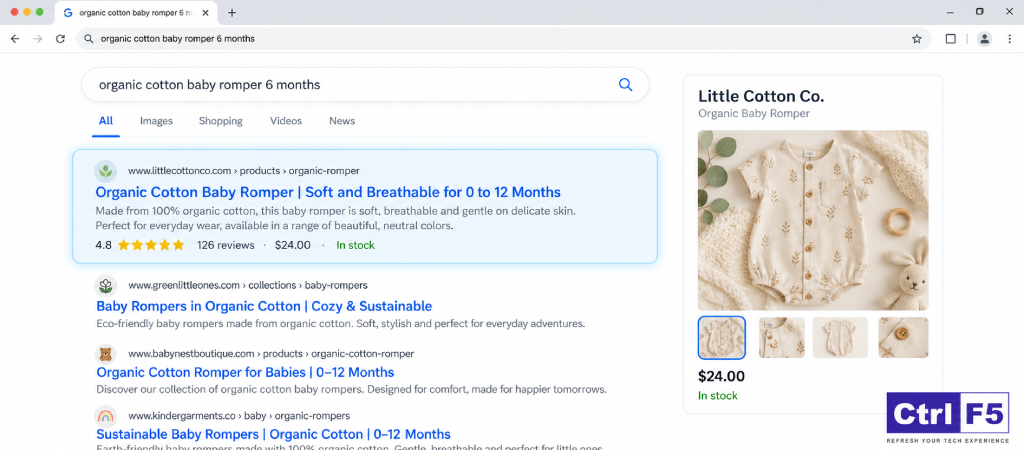
Google sends small programs called crawlers to read your pages. Based on what they find, Google decides which search each page fits and where it should appear in the results.
On Shopify, a lot of the technical basics are handled for you. Your Shopify store gets a sitemap, clean URLs and editable title tags out of the box. What Shopify cannot do for you is write a product page that actually deserves to rank. That part is still on you.
Google also checks whether your page is the type of page the searcher wants to see. For a search like “how to choose a baby romper,” Google mostly shows guides and blog posts. For “buy organic baby romper,” it shows product and collection pages. Before you pick a search to target, look at what already ranks for it.
If Google shows blog posts and you are trying to rank a product page, you will struggle no matter how well that page is written.
And if your pages are live but still not showing up, here is how to fix ranking issues on your Shopify store step by step.
For a Shopify store, SEO is how shoppers find you without you paying for every visit. Someone searching “organic cotton baby romper size 6 months” knows exactly what they want. If your product page shows up for that search, the path from Google to checkout is very short.
It also keeps working over time. Ads stop the day you stop paying, but a page that ranks can keep bringing visitors to your Shopify store for months with only small updates. And since many AI tools pull from search results to build their answers, strong SEO also gives your Shopify store a better chance of showing up there.
SEO also tells you what your buyers want. The search terms that bring people to your Shopify store show the exact words they use, and those words often point to demand you did not plan for, like a size, color or a specific need shoppers keep looking for, such as a romper for travel or a newborn photoshoot.
GEO stands for generative engine optimization. It is the work of getting your brand and products mentioned when people ask AI tools like ChatGPT, Gemini or Perplexity for advice.
These tools work differently from Google. Instead of showing a list of links, they write a single answer. If a shopper asks “what is a good organic baby romper brand,” the AI might name two or three brands right there in the reply. GEO is about making sure your Shopify store is one of the names it picks.
Being named is only half of GEO. The AI also has to describe your products correctly, with the right materials, the right price range and the right type of buyer.
If it calls your premium organic romper a cheap pick or gets the fabric wrong, the mention can send away the very shoppers you want.
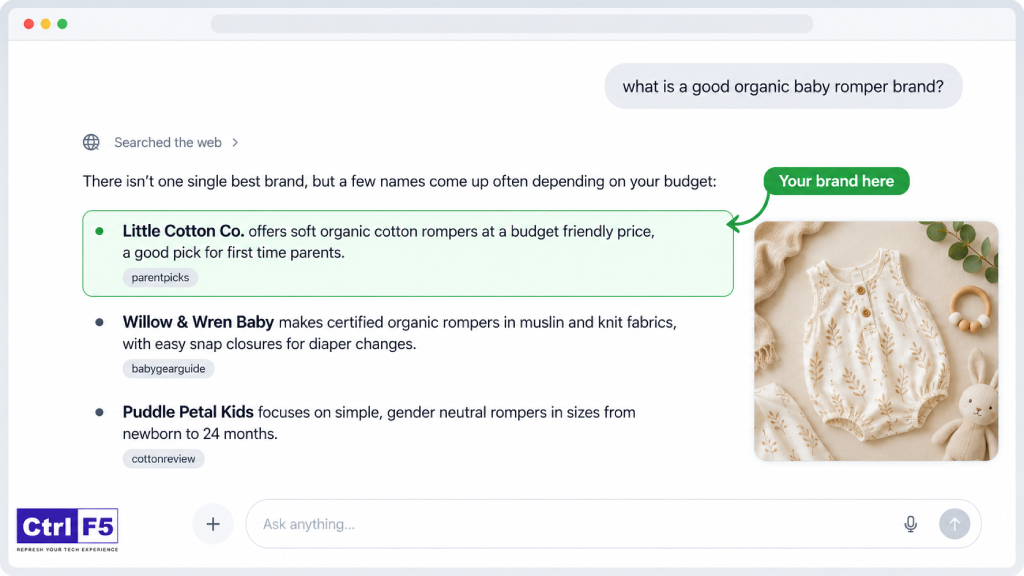
These tools are built on large language models. When someone asks a question, the tool pulls from what the model learned during training and, in many cases, from live web results it fetches right then. It writes one answer and sometimes lists the sources it used.
Nobody outside these companies has the full list of AI search ranking factors. From what my team has tested on client sites, a few things keep showing up again and again:
Shoppers now ask AI tools things like “what is a good gift for a new mom under $50” or “which running shoes work for flat feet.” The tool replies with specific brands and products. Shopify has also been building ways for Shopify merchants’ product catalogs to reach AI shopping experiences, so product data from Shopify stores is reaching these answers more directly than before.
That means a shopper may hear about your product, compare it and decide, all before they ever visit your Shopify store.
Look closely at those questions and you will see they come with conditions, such as a price limit, a specific problem or a type of person. The AI can only recommend your product if it can match it to those conditions. If your price, sizes or the need it solves are missing or unclear, your product gets left out of the answer, even when it fits perfectly.
If you want your products to be part of these answers, here is how to get your Shopify products recommended by AI tools like ChatGPT, Google AI and Perplexity.
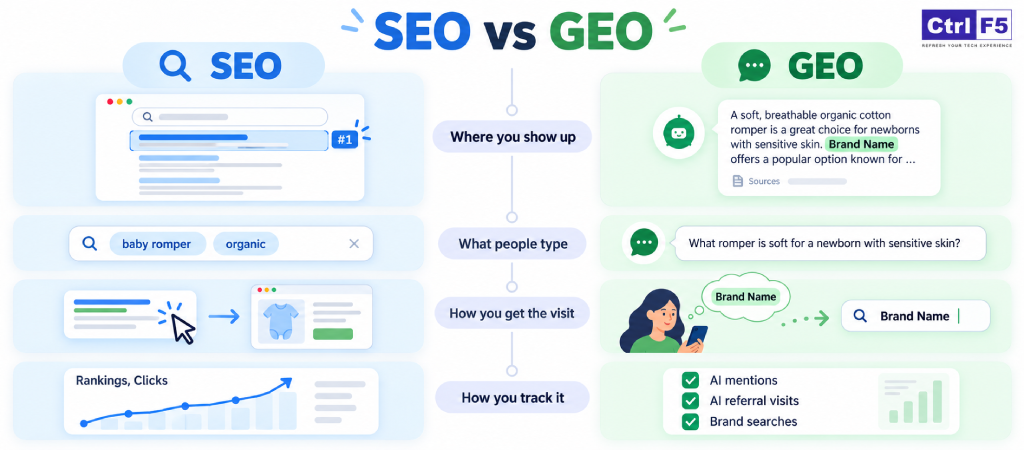
The tactics overlap a lot, but the difference between SEO and GEO comes down to where the shopper meets you and what counts as a win.
Rankings vs Citations: In SEO, you want a high spot on a results page. In GEO, there is no page two. Either the AI mentions you or it does not. Being cited as a source or named as a recommendation is the GEO version of ranking.
Keywords vs Questions and context: SEO has always leaned on keywords. You find what people type and build pages around those phrases. AI tools deal with full questions, often long and personal, like “I have a small balcony with no sunlight, what plants can I grow?” Your content has to cover the situation behind the question, not only the phrase.
Clicks vs Brand mentions: SEO success usually means a click to your site. With GEO, the shopper might read the answer, remember your brand name and search for you directly later. Some of the value shows up as branded searches and direct visits instead of a click from the AI tool.
How each one measures success: SEO has mature tools. Google Search Console shows you impressions, clicks and positions. GEO measurement is still rough. You track mentions, referral visits from AI tools and how often your brand appears when you test common buyer questions. It needs more manual checking, at least for now.
This is the part that should calm most Shopify merchants down. A large share of good GEO work is simply good SEO done properly.
Content quality and clear structure: Both Google and AI tools reward pages that answer questions clearly. Short paragraphs, honest headings and specific details like materials, sizes and use cases. A product page written to help a real buyer usually helps in both places.
Product data, schema and reviews: Structured data tells machines exactly what your page holds: price, availability, ratings and product type. Most modern Shopify themes include basic product schema, but it is often incomplete. Reviews matter in both worlds too, because they add real customer language and trust signals that search engines and AI tools can read.
Site speed and crawlability: If a crawler cannot load your page, neither Google nor an AI tool that fetches live results can use it. Heavy Shopify apps, broken links and pages blocked by mistake hurt both channels equally. When my team audits a Shopify store, this is often where we find the quickest wins.
If your pages take too long to load, start by checking the hidden causes that slow down a Shopify store, since most of them are easy to fix once you know where to look.
Not sure which issues are holding your Shopify store back in Google and AI answers?
We can find them for you.
Short answer: yes. The real question is how much attention each one deserves for your business right now.
When SEO alone is still enough: If your Shopify store sells in a narrow local market, or your buyers search for exact product codes and part numbers, SEO will carry most of the weight. People in those situations rarely ask an AI for open advice. They search, compare and buy.
When ignoring GEO starts costing you sales: If your products are the kind people ask for advice about, GEO matters more. Think gifts, skincare, baby products, supplements, home décor and fitness gear. These are the categories where shoppers type full questions into AI tools. If your competitors appear in those answers and you do not, you lose shoppers you never even knew were looking. That is why LLM visibility has become a regular part of how I plan growth for clients in these niches.
How to split your effort between the two: For most of the Shopify merchants I work with, a sensible Shopify AI strategy looks like this: keep SEO as the base, because it feeds both channels, and layer GEO work on top. In practice, most of your effort still goes into strong pages and technical health, with a steady slice going toward answer-focused content, brand mentions and checking how AI tools describe you.
These are the steps my team follows when we build a Shopify AI strategy for a client. None of them need a big budget, just consistency.
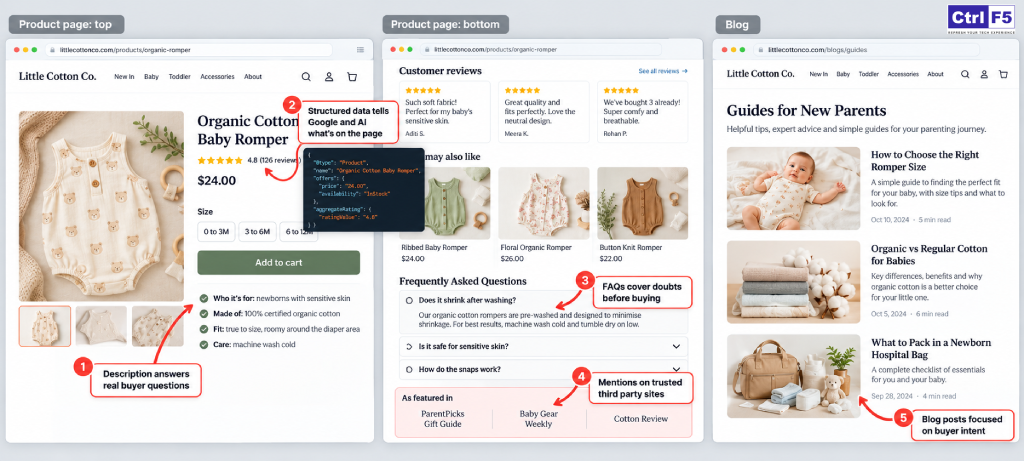
Making any of these mistakes?
Let my team fix them before they cost you more shoppers.
Tracking is still basic, but it is doable. Put these tracking methods together and you get a fair picture of your LLM visibility without paying for expensive tools:
GEO and SEO are not rivals fighting for your budget. The real difference between SEO and GEO is simple: SEO helps shoppers find your Shopify store on Google, and GEO helps AI tools suggest your Shopify store when shoppers ask for advice.
The Shopify merchants I see doing well right now are not picking one. They build a solid SEO base and then make sure every page, review and brand mention gives AI tools a clear reason to name them.
If you are unsure where your Shopify store stands, start with the monthly prompt test. It takes less than an hour and quickly shows whether you are part of the conversation or missing from it.
If you would like generative engine optimization explained for your own catalog, along with a clear plan to act on it, my team at ControlF5, one of the best Shopify agencies, audits Shopify stores for both search and AI visibility and then fixes what is holding them back.
Get Your Shopify Store Checked by ControlF5
Question: Is GEO replacing SEO for Shopify stores?
Answer: No. GEO builds on SEO. Many AI tools pull live results from search engines, so pages that are invisible in search are often invisible in AI answers too. Think of GEO as an extra layer on top of your SEO work.
Question: Can I do GEO without doing SEO first?
Answer: You can try, but it rarely works well. Crawlable pages, clear content and structured data are SEO basics, and they are also the first things AI tools need. Fix those before anything else.
Question: How long does it take to see GEO results on a Shopify store?
Answer: There is no fixed timeline. Changes to your own pages can be picked up whenever AI tools fetch fresh results, while getting mentioned across other websites takes steady effort over months. Track monthly and look for direction rather than overnight jumps.
Question: What is the first step to improve GEO for my Shopify store?
Answer: Start by asking ChatGPT, Gemini and Perplexity the questions your buyers would ask. See whether your brand appears and what is said about you. That quick check shows you exactly where the gaps are before you change anything.
Question: Will AI search reduce traffic to my Shopify store?
Answer: Some simple questions may get answered without a click. But shoppers who do visit after an AI recommendation usually already know what they want, so they tend to be closer to buying. Improving your LLM visibility helps you stay in front of those shoppers.



Subscription options missing from your Shopify product page? Find out what causes it and how to fix it.
Should a growing brand pay for a Shopify theme or stick with a free one? Here is how to decide based on what your Shopify store needs now and later.
Most Shopify subscription churn comes from small, fixable problems. Here are the 8 most common reasons subscribers cancel and how to fix each one.